

Over more than two years, one Vessel Longevity patient went from 298 pounds and 37% body fat to 212 pounds and 14% body fat—while making strength, muscle, metabolic health, and longevity part of the goal.
But the most important part of his story is not the number on the scale.
It is the shift from trying to lose weight to building a body capable of supporting the life he wants to live for decades to come.
At Vessel Longevity, we look at weight as one part of a much bigger picture: body composition, skeletal muscle, visceral fat, metabolic health, hormones, energy, movement, recovery, and long-term function.
This patient’s experience shows what that approach can look like when physician-led care is combined with training, lifestyle changes, and long-term consistency.
The Starting Point: “This Is Not Who I Am”
His journey began in March 2024.
He was already training consistently. The problem was that his body no longer seemed to be responding.
He was putting in the work, but he was not seeing the changes he expected.
Then he saw a photograph of himself.
That photograph became the turning point.
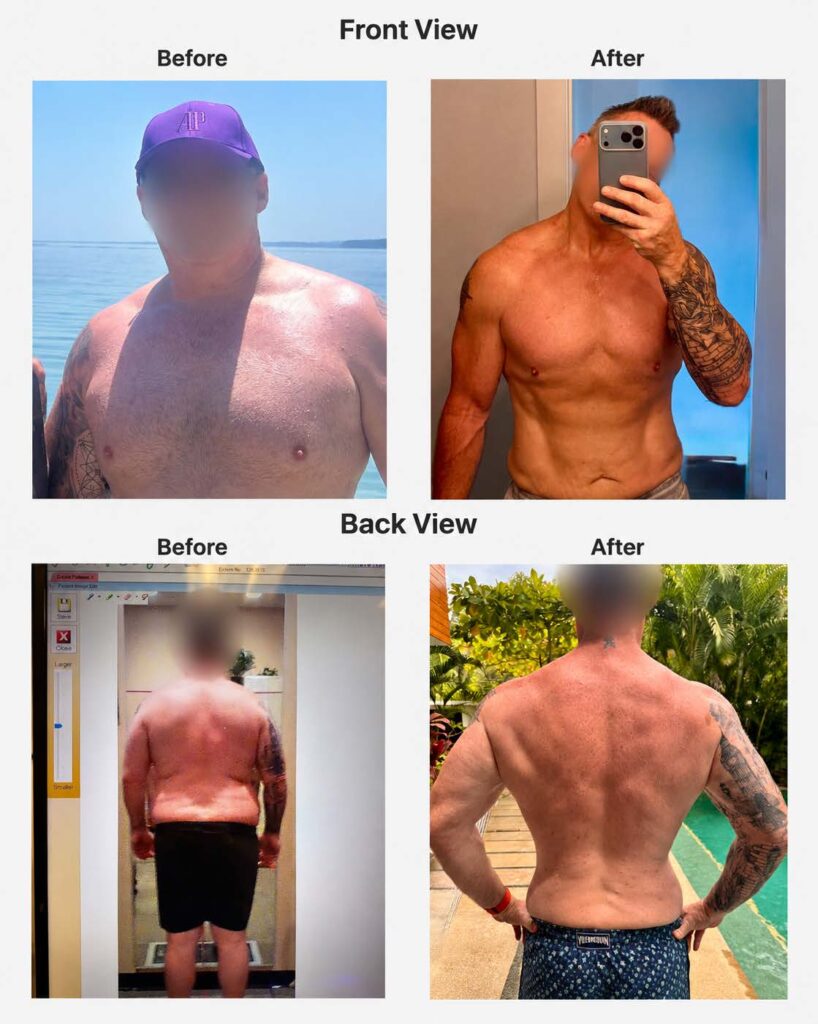
He described realizing that the person he saw in the image did not reflect who he believed himself to be or the future he wanted. He made a mental decision that something needed to change. A friend eventually recommended that he meet with Dr. Emeka at Vessel Longevity.
His baseline numbers reflected the challenge in front of him:
- Weight: 298 lbs
- Fat mass: 111 lbs
- Body fat: 37%
- Skeletal muscle mass: approximately 106 lbs
- Visceral fat: 20
- Health score: approximately 58
- Body age estimate: 54
The goal, however, quickly became bigger than reaching a certain weight.
The Strategy: More Than a Weight Loss Injection
Testing revealed that his testosterone was low, which became one part of a broader physician-led plan.
His care included hormone replacement therapy, GLP-1 medication, peptide therapy, vitamins and minerals, along with continued exercise and lifestyle changes. He later reported that he primarily continued with peptides and testosterone replacement therapy, using a small amount of GLP-1 periodically as part of his ongoing plan.
That distinction matters.
For this patient, GLP-1 was not the whole plan.
Medication was one tool within a larger strategy that included:
- hormone evaluation and treatment
- GLP-1 therapy
- peptide therapy
- strength training
- personal training
- running and regular movement
- vitamins and nutritional support
- attention to body composition
- sustainable lifestyle habits
He continued training even when progress had previously felt frustrating.
And as his health changed, his goals changed too.
From Weight Loss to Longevity
One of the most meaningful parts of his story was how he began thinking about weight loss itself.
He described weight loss as simply one component of his longevity journey.
Rather than training for a wedding, vacation, or another short-term milestone, he began training for something much bigger.
He wants to see his daughters walk down the aisle.
He wants to see his grandchildren.
He wants his body to support the life he plans to continue living.
As he explained it, once weight loss became part of the longevity journey rather than the final destination, the entire process changed.
That philosophy closely reflects how we think about care at Vessel.
The goal is not simply:
How much weight can we help someone lose?
The better questions are:
What kind of weight are they losing?
What is happening to their muscle?
What is happening to visceral fat?
Are they getting stronger?
Is their body becoming better prepared for the years ahead?
The Results: More Than 80 Pounds of Fat Lost
By August 2026, his numbers had changed dramatically.
His weight decreased from 298 pounds to 212 pounds—an overall change of approximately 86 pounds.
But body composition tells the more important story.
His fat mass decreased from 111 pounds to approximately 29 pounds.
His body fat percentage dropped from 37% to 14%.
His visceral fat score decreased from 20 to 3.
His health score increased from approximately 58 to 97.
And his reported metabolic age changed from 54 to 46, while his chronological age at the time of the testimony was 49.
Starting vs. Current
Weight
298 lbs → 212 lbs
Fat Mass
111 lbs → 29 lbs
Body Fat
37% → 14%
Visceral Fat
20 → 3
Health Score
58 → 97
Body / Metabolic Age Estimate
54 → 46
Skeletal Muscle Mass
Approximately 106 lbs → 107 lbs
That last number is especially meaningful.
While losing a substantial amount of overall body weight and more than 80 pounds of body fat, his skeletal muscle measurement remained remarkably strong.
That is the difference between focusing only on weight loss and paying attention to body composition.
Why Muscle Became Part of the Goal
For adults pursuing significant weight loss, preserving muscle deserves attention.
At Vessel Longevity, we do not want the only measure of success to be how quickly the scale moves.
We want to consider the quality of that weight loss.
Strength training, adequate nutrition, hormone health when appropriate, recovery, hydration, and body composition monitoring can all become part of a more comprehensive medical weight loss strategy.
For this patient, training remained a consistent part of the process.
By the time of his latest update, he reported 107 pounds of skeletal muscle mass and 172 pounds of total muscle mass, along with a visceral fat score of 3 and subcutaneous fat measurement of 9.9%.
He also reported that he was continuing to build muscle.
The goal was no longer simply to become lighter.
It was to become stronger.
A Lifestyle He Could Actually Maintain
Another important part of this transformation is what he did not do.
He did not describe an extreme lifestyle where every enjoyable food, social dinner, or drink disappeared forever.
Instead, he built habits he believed he could continue.
He walks through the hills of Austin to the gym, strength trains, walks back, uses intermittent fasting when appropriate, and generally pays attention to how he eats.
But he still enjoys dinner with family and friends. He still occasionally has dessert, chocolate, or a drink.
His philosophy is consistency rather than perfection.
That may be one of the most important lessons from the entire transformation.
Longevity has to become a lifestyle—not a temporary challenge.
Improving More Than Appearance
The physical transformation was substantial, but he also described changes that could not be captured by a scale.
He reported improvements in confidence, mental clarity, and how he felt about himself.
And those changes reinforced something he had come to believe throughout the process:
Medication can be helpful, but longevity still requires participation.
Training matters.
Nutrition matters.
Consistency matters.
The habits that support the body after weight loss matter just as much as the interventions that helped begin the transformation.
The Takeaway: Weight Loss Is Part of the Journey
This case began with a man who wanted to change his weight.
It became something much bigger.
Over the course of his journey, he:
- lost approximately 86 pounds of total body weight
- reduced fat mass by approximately 82 pounds
- moved from 37% to 14% body fat
- reduced visceral fat from 20 to 3
- maintained strong skeletal muscle measurements
- improved his health score from approximately 58 to 97
- improved his estimated metabolic/body age from 54 to 46
- continued building strength and sustainable lifestyle habits
But perhaps the biggest transformation was how he defined success.
He stopped training simply to lose weight.
He started training for longevity.
That means building the strength, metabolic health, body composition, movement, and resilience needed to continue doing the things that matter most.
At Vessel Longevity, that is the bigger goal of physician-led medical weight management.
Not simply helping patients weigh less.
Helping them build a body that is better supported for the life ahead.
Start With the Bigger Picture
If you are considering medical weight loss, your starting weight is only one piece of information.
Body composition, muscle, visceral fat, metabolic health, hormones, nutrition, lifestyle, and long-term goals can all help shape a more personalized strategy.
Schedule a consultation with Vessel Longevity and discover a physician-led approach to medical weight loss, body composition, and long-term health.
Cedar Park: 512-337-7722
Lakeway: 512-489-7997
Individual results vary. This patient case is provided for educational purposes and does not predict or guarantee similar results. Treatment plans are individualized and should be developed with a qualified medical provider.