
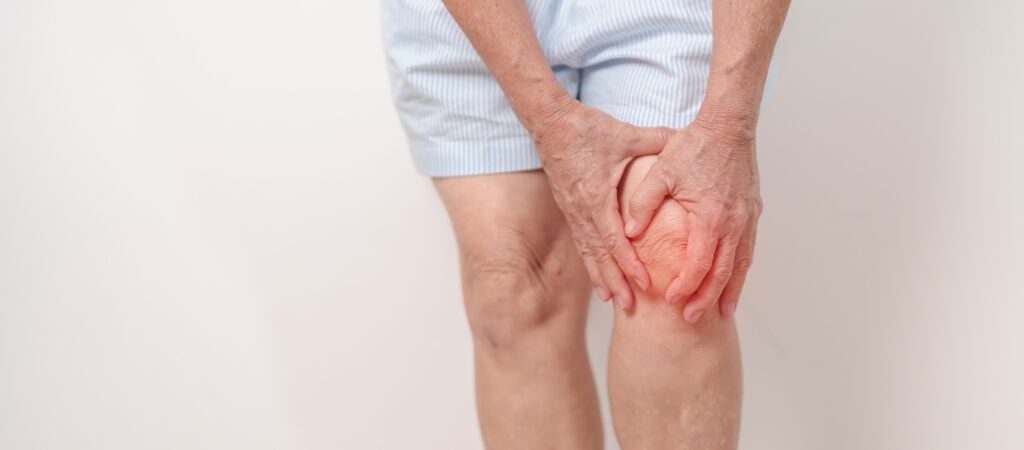
Knee pain is one of the most common reasons people slow down, avoid certain activities, or feel like their body is aging faster than it should.
For some, it starts as a dull ache after exercise. For others, it shows up as stiffness in the morning, swelling after a long day, pain going up and down stairs, or discomfort that makes it harder to walk, squat, kneel, or stay active.
Many people assume knee pain is simply “inflammation.”
Very generally speaking, inflammation is the body’s immune system’s response to an irritant. The irritant might be a germ, but it could also be a foreign object, such as a splinter in your finger.
And inflammation can absolutely be part of the picture. But knee pain is often more complex than that.
At Vessel Longevity, we look at knee pain through a broader lens. Pain may be connected to inflammation, but it may also involve joint structure, cartilage health, muscle strength, movement patterns, past injuries, weight, hormones, recovery, or the body’s ability to repair tissue over time.
In other words, the question is not only, “How do we calm inflammation?”
The better question is, “Why is the knee irritated in the first place?”
Knee Pain Can Have Many Causes
The knee is a complicated joint. It depends on bones, cartilage, ligaments, tendons, muscles, fluid, nerves, and surrounding tissues all working together.
When one part of that system is under stress, the whole joint can feel it.
Knee pain may be related to:
- Arthritis or joint degeneration
- Cartilage wear
- Meniscus irritation or tears
- Ligament injuries
- Tendon strain
- Bursitis
- Muscle weakness
- Poor movement mechanics
- Previous injuries
- Hip, ankle, or foot imbalances
- Excess joint load
- Inflammation or metabolic stress
That is why two people can both say, “My knee hurts,” but need very different treatment plans.
One person may have inflammation from overuse. Another may have cartilage changes. Another may have a strength imbalance affecting how the knee tracks. Another may have an old injury that never fully healed.
Pain is a signal. The goal is to understand what the signal is pointing to.
Inflammation Is Only One Piece of the Puzzle
Inflammation is the body’s natural response to irritation, injury, or stress. When the knee becomes inflamed, it may feel swollen, stiff, warm, tender, or painful.
But inflammation often develops for a reason.
If the joint is overloaded, unstable, poorly supported, or repeatedly stressed, inflammation may keep coming back. In that case, only trying to reduce inflammation may not address the underlying problem.
This is why knee pain can become frustrating.
Someone may rest, ice, take anti-inflammatory medication, stretch, or avoid certain movements. They may feel better for a little while. But as soon as they return to normal activity, the pain comes back.
That does not mean they failed.
It may mean the knee needs a more complete evaluation.
Joint Health Is Also About Mechanics
The knee does not work alone. It sits between the hip and ankle, which means the way you walk, stand, squat, climb stairs, run, or exercise can affect how much stress goes through the joint.
If the hips are weak, the knees may absorb more strain.
If the feet or ankles are not moving well, the knees may compensate.
If one side of the body is stronger than the other, the knee may be loaded unevenly.
If the muscles around the knee are not supporting the joint properly, the joint itself may take more stress than it should.
Over time, those movement patterns can contribute to irritation, wear, pain, or reduced function.
That is why knee pain is not just a joint issue. It can also be a movement issue.
Cartilage, Recovery, and Tissue Support Matter
Cartilage helps cushion the joint and allows smooth movement. Tendons and ligaments help stabilize and support the knee. Muscles help absorb force and protect the joint during activity.
When these tissues are irritated, weakened, or not recovering well, pain can become more persistent.
This is especially important for people who are active, aging, recovering from injury, or noticing that their body does not bounce back the way it used to.
Recovery is part of longevity.
The ability to repair, rebuild, and maintain healthy tissue affects how well you move over time. If recovery is poor, inflammation can linger, pain can increase, and movement can become more limited.
That is why a longevity-focused approach to knee pain may include looking at sleep, nutrition, hydration, inflammation, hormone balance, cellular health, body composition, and regenerative support.
The knee is local.
But healing is systemic.
Weight and Metabolic Health Can Affect the Knees
Knee pain is not always just about the knee itself.
Body weight, muscle mass, blood sugar regulation, inflammation, and metabolic health may all influence joint stress and recovery.
For example, extra weight can increase mechanical load on the knees. But metabolism also matters because chronic low-grade inflammation may affect how the body responds to pain, injury, and tissue stress.
This does not mean knee pain is someone’s fault.
It means the body is connected.
A complete plan may need to support both the joint and the internal environment that affects healing, inflammation, and long-term function.
When Knee Pain Needs a Deeper Look
Occasional soreness after activity is common. But ongoing or worsening knee pain should not be ignored.
It may be time to seek a deeper evaluation if you notice:
- Pain that lasts more than a few weeks
- Swelling or stiffness
- Pain that limits walking, stairs, exercise, or daily life
- A feeling of instability or giving way
- Pain after a previous injury
- Reduced range of motion
- Pain that keeps returning after rest
- Difficulty staying active because of discomfort
A proper evaluation can help identify whether the issue is inflammatory, structural, mechanical, regenerative, or a combination of several factors.
A More Personalized Approach to Knee Pain
At Vessel Longevity, we believe knee pain should be approached with curiosity, not assumptions.
The goal is not simply to cover up discomfort. The goal is to better understand what is driving the pain and what kind of support may help restore movement, function, and quality of life.
Depending on the individual, care may include a conversation around regenerative medicine, peptide therapy, inflammation support, body composition, IV nutrient therapy, hormone optimization, medical weight loss, or a broader longevity plan.
There is no one-size-fits-all answer.
The right plan depends on your history, symptoms, goals, lifestyle, and what your body needs.
Preserve Movement. Protect Function.
Knee pain can change the way you live.
It can make you move less, exercise less, avoid stairs, stop doing activities you enjoy, or feel less confident in your body.
But pain does not have to be ignored until it becomes a bigger problem.
If your knee pain keeps returning, it may be more than inflammation. It may be your body asking for a deeper look.
At Vessel Longevity, our physician-led team helps patients explore personalized options to support mobility, recovery, and long-term function.
Because longevity is not only about living longer.
It is about moving well, recovering well, and protecting the quality of life you want for the years ahead.
Schedule a consultation with Vessel Longevity in Cedar Park or Lakeway.
Cedar Park: 512-337-7722
Lakeway: 512-489-7997